Pythagoras Theorem

Pythagoras Theorem
The Pythagoras theorem which is also referred to as the Pythagorean theorem explains the relationship between the three sides of a right-angled triangle. According to the Pythagorean theorem, the square of the hypotenuse is equal to the sum of the squares of the other two sides of a triangle. Let us learn more about the Pythagoras theorem, the Pythagoras theorem formula, and the proof of Pythagoras theorem along with examples.
What is the Pythagoras Theorem?
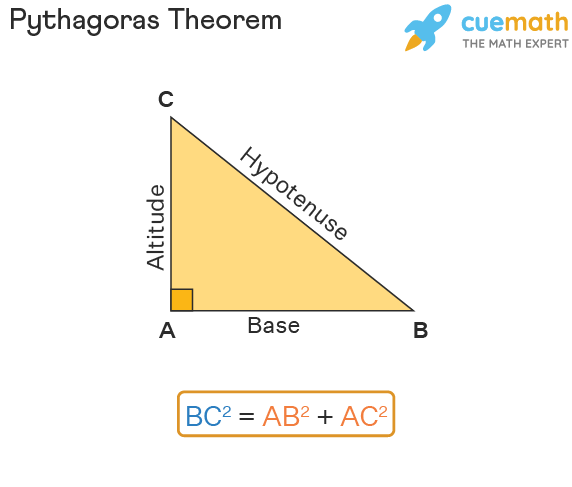
The Pythagoras theorem states that if a triangle is a right-angled triangle, then the square of the hypotenuse is equal to the sum of the squares of the other two sides. Observe the following triangle ABC, in which we have BC2 = AB2 + AC2. Here, AB is the base, AC is the altitude (height), and BC is the hypotenuse. It is to be noted that the hypotenuse is the longest side of a right-angled triangle.
Pythagoras Theorem Equation
The Pythagoras theorem equation is expressed as, c2 = a2 + b2, where 'c' = hypotenuse of the right triangle and 'a' and 'b' are the other two legs. Hence, any triangle with one angle equal to 90 degrees produces a Pythagoras triangle and the Pythagoras equation can be applied in the triangle.
History of Pythagoras Theorem
Pythagoras theorem was introduced by the Greek Mathematician Pythagoras of Samos. He was an ancient Greek philosopher who formed a group of mathematicians who worked religiously on numbers and lived like monks. Although Pythagoras introduced the theorem, there is evidence that proves that it existed in other civilizations too, 1000 years before Pythagoras was born. The oldest known evidence is seen between the 20th to the 16th century B.C in the Old Babylonian Period.

Pythagoras Theorem Formula
The Pythagorean theorem formula states that in a right triangle ABC, the square of the hypotenuse is equal to the sum of the squares of the other two legs. If AB and AC are the sides and BC is the hypotenuse of the triangle, then: BC2 = AB2 + AC2. In this case, AB is the base, AC is the altitude or the height, and BC is the hypotenuse.
Another way to understand the Pythagorean theorem formula is using the following figure which shows that the area of the square formed by the longest side of the right triangle (the hypotenuse) is equal to the sum of the area of the squares formed by the other two sides of the right triangle.
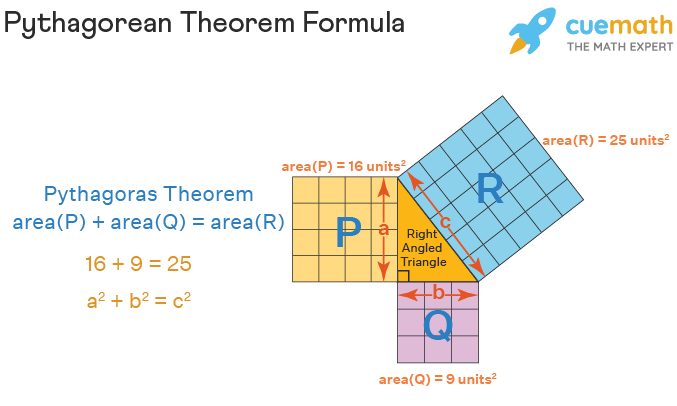
In a right-angled triangle, the Pythagoras Theorem Formula is expressed as:
c2 = a2 + b2
Where,
- 'c' = hypotenuse of the right triangle
- 'a' and 'b' are the other two legs.
Pythagoras Theorem Proof
The Pythagoras theorem can be proved in many ways. Some of the most common and widely used methods are the algebraic method and the similar triangles method. Let us have a look at both these methods individually in order to understand the proof of this theorem.
Proof of Pythagorean Theorem Formula using the Algebraic Method
The proof of the Pythagoras theorem can be derived using the algebraic method. For example, let us use the values a, b, and c as shown in the following figure and follow the steps given below:
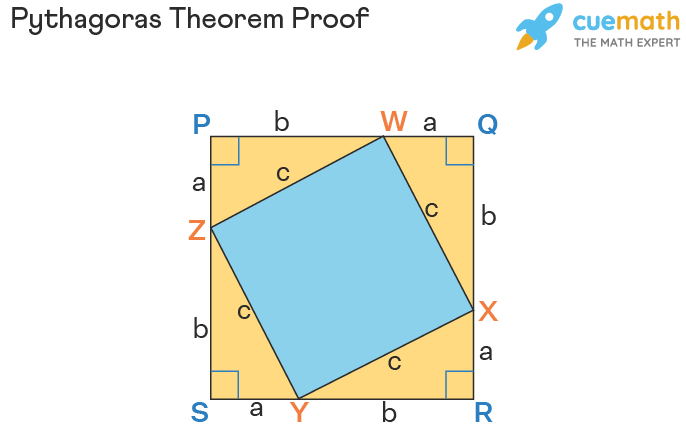
- Step 1: This method is also known as the 'proof by rearrangement'. Take 4 congruent right-angled triangles, with side lengths 'a' and 'b', and hypotenuse length 'c'. Arrange them in such a way that the hypotenuses of all the triangles form a tilted square. It can be seen that in the square PQRS, the length of the sides is 'a + b'. The four right triangles have 'b' as the base, 'a' as the height and, 'c' as the hypotenuse.
- Step 2: The 4 triangles form the inner square WXYZ as shown, with 'c' as the four sides.
- Step 3: The area of the square WXYZ by arranging the four triangles is c2.
- Step 4: The area of the square PQRS with side (a + b) = Area of 4 triangles + Area of the square WXYZ with side 'c'. This means (a + b)2 = [4 × 1/2 × (a × b)] + c2.This leads to a2 + b2 + 2ab = 2ab + c2. Therefore, a2 + b2 = c2. Hence, the Pythagoras theorem formula is proved.

Pythagorean Theorem Formula Proof using Similar Triangles
Two triangles are said to be similar if their corresponding angles are of equal measure and their corresponding sides are in the same ratio. Also, if the angles are of the same measure, then by using the sine law, we can say that the corresponding sides will also be in the same ratio. Hence, corresponding angles in similar triangles lead us to equal ratios of side lengths.
Derivation of Pythagorean Theorem Formula
Consider a right-angled triangle ABC, right-angled at B. Draw a perpendicular BD meeting AC at D.
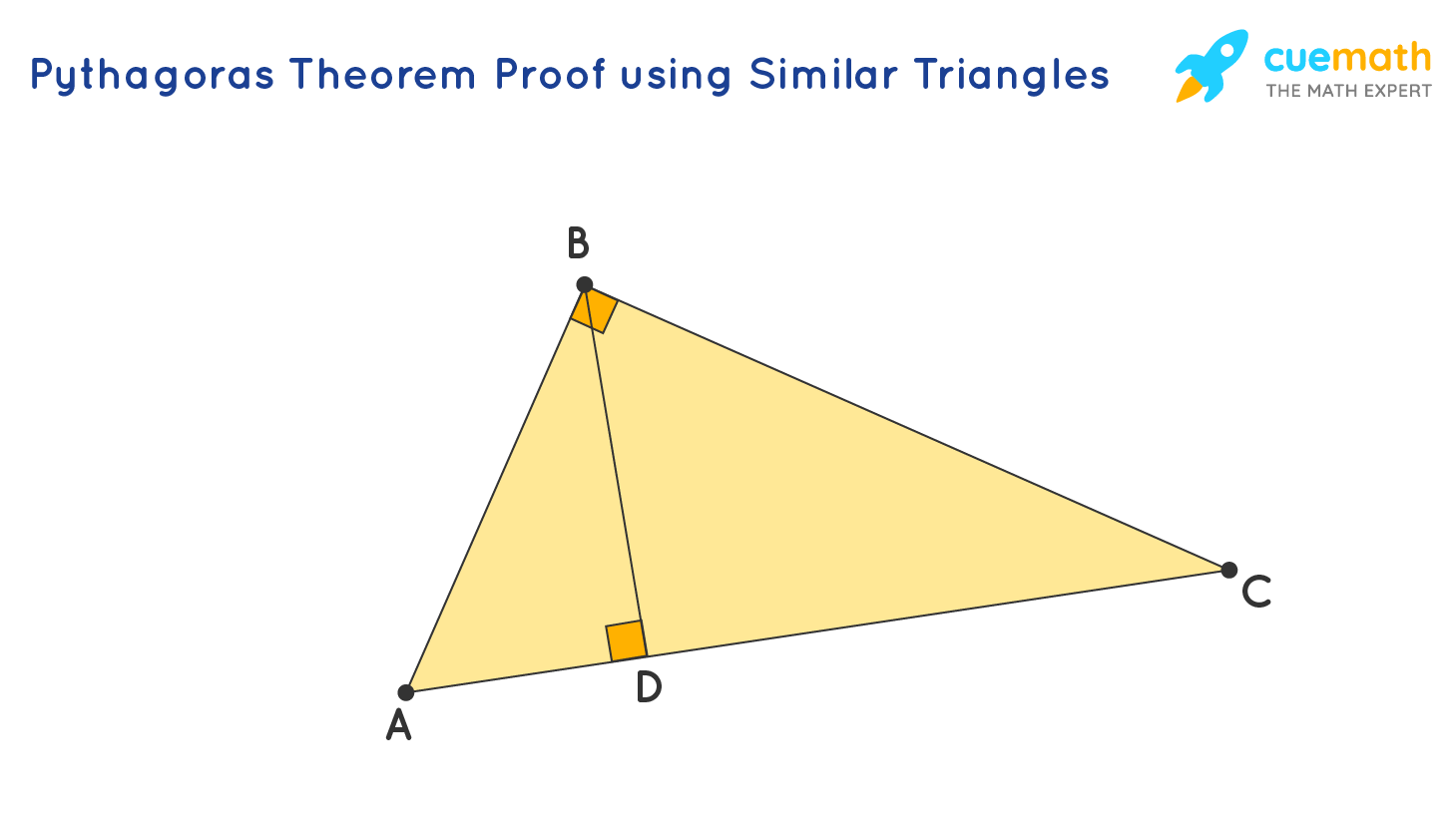
In △ABD and △ACB,
- ∠A = ∠A (common)
- ∠ADB = ∠ABC (both are right angles)
Thus, △ABD ∼ △ACB (by AA similarity criterion)
Similarly, we can prove △BCD ∼ △ACB.
Thus △ABD ∼ △ACB, Therefore, AD/AB = AB/AC. We can say that AD × AC = AB2.
Similarly, △BCD ∼ △ACB. Therefore, CD/BC = BC/AC. We can also say that CD × AC = BC2.
Adding these 2 equations, we get AB2 + BC2 = (AD × AC) + (CD × AC)
AB2 + BC2 =AC(AD +DC)
AB2 + BC2 =AC2
Hence proved.
Pythagoras Theorem Triangles
Right triangles follow the rule of the Pythagoras theorem and they are called Pythagoras theorem triangles. The three sides of such a triangle are collectively called Pythagoras triples. All the Pythagoras theorem triangles follow the Pythagoras theorem which says that the square of the hypotenuse is equal to the sum of the two sides of the right-angled triangle. This can be expressed as c2 = a2 + b2; where 'c' is the hypotenuse and 'a' and 'b' are the two legs of the triangle.
Pythagoras Theorem Squares
As per the Pythagorean theorem, the area of the square which is built upon the hypotenuse of a right triangle is equal to the sum of the area of the squares built upon the other two sides. These squares are known as Pythagoras squares.
Applications of Pythagoras Theorem
The applications of the Pythagoras theorem can be seen in our day-to-day life. Here are some of the applications of the Pythagoras theorem.
- Engineering and Construction fields
Most architects use the technique of the Pythagorean theorem to find the unknown dimensions. When the length or breadth is known it is very easy to calculate the diameter of a particular sector. It is mainly used in two dimensions in engineering fields.
- Face recognition in security cameras
The face recognition feature in security cameras uses the concept of the Pythagorean theorem, that is, the distance between the security camera and the location of the person is noted and well-projected through the lens using the concept.
- Woodwork and interior designing
The Pythagoras concept is applied in interior designing and the architecture of houses and buildings.
- Navigation
People traveling in the sea use this technique to find the shortest distance and route to proceed to their concerned places.
Pythagoras Theorem (also called Pythagorean Theorem) is an important topic in Mathematics, which explains the relation between the sides of a right-angled triangle. The sides of the right triangle are also called Pythagorean triples. The formula and proof of this theorem are explained here with examples.
Pythagoras theorem is basically used to find the length of an unknown side and the angle of a triangle. By this theorem, we can derive the base, perpendicular and hypotenuse formulas. Let us learn the mathematics of the Pythagorean theorem in detail here.
Pythagoras Theorem Statement
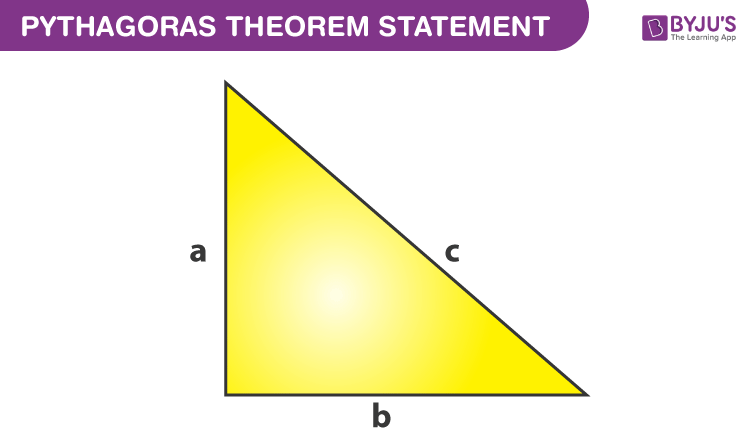
Pythagoras theorem states that “In a right-angled triangle, the square of the hypotenuse side is equal to the sum of squares of the other two sides“. The sides of this triangle have been named Perpendicular, Base and Hypotenuse. Here, the hypotenuse is the longest side, as it is opposite to the angle 90°. The sides of a right triangle (say a, b and c) which have positive integer values, when squared, are put into an equation, also called a Pythagorean triple.
History
The theorem is named after a Greek Mathematician called Pythagoras.
Pythagoras Theorem Formula
Consider the triangle given above:
Where “a” is the perpendicular,
“b” is the base,
“c” is the hypotenuse.
According to the definition, the Pythagoras Theorem formula is given as:
| Hypotenuse2 = Perpendicular2 + Base2 c2 = a2 + b2 |
The side opposite to the right angle (90°) is the longest side (known as Hypotenuse) because the side opposite to the greatest angle is the longest.
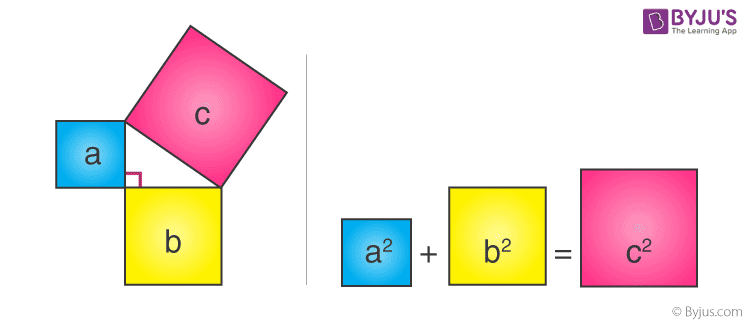
Consider three squares of sides a, b, c mounted on the three sides of a triangle having the same sides as shown.
By Pythagoras Theorem –
Area of square “a” + Area of square “b” = Area of square “c”
Example
The examples of theorem and based on the statement given for right triangles is given below:
Consider a right triangle, given below:
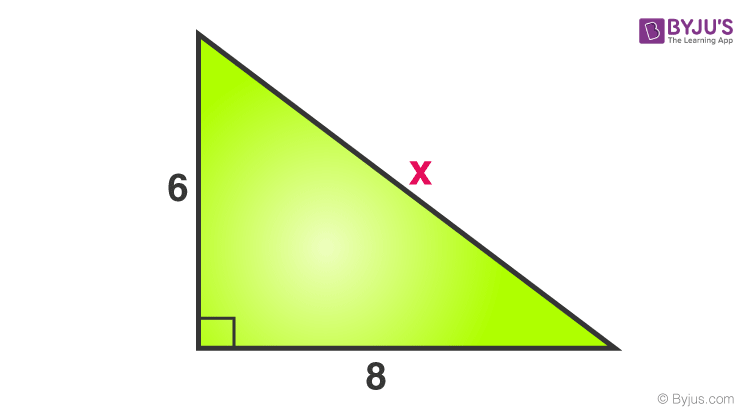
Find the value of x.
X is the side opposite to the right angle, hence it is a hypotenuse.
Now, by the theorem we know;
Hypotenuse2 = Base2 + Perpendicular2
x2 = 82 + 62
x2 = 64+36 = 100
x = √100 = 10
Therefore, the value of x is 10.
Pythagoras Theorem Proof
Given: A right-angled triangle ABC, right-angled at B.
To Prove- AC2 = AB2 + BC2
Construction: Draw a perpendicular BD meeting AC at D.
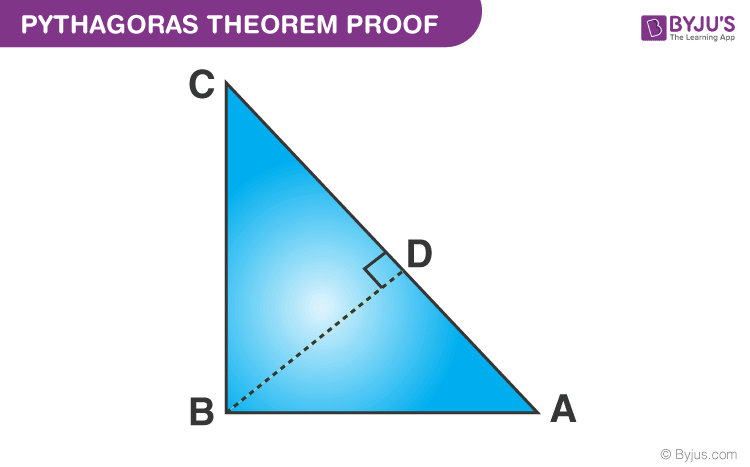
Proof:
We know, △ADB ~ △ABC
Therefore,
(corresponding sides of similar triangles)
Or, AB2 = AD × AC ……………………………..……..(1)
Also, △BDC ~△ABC
Therefore,
(corresponding sides of similar triangles)
Or, BC2= CD × AC ……………………………………..(2)
Adding the equations (1) and (2) we get,
AB2 + BC2 = AD × AC + CD × AC
AB2 + BC2 = AC (AD + CD)
Since, AD + CD = AC
Therefore, AC2 = AB2 + BC2
Hence, the Pythagorean theorem is proved.
Note: Pythagorean theorem is only applicable to Right-Angled triangle.
Video Lesson on Pythagoras Theorem

Applications of Pythagoras Theorem
- To know if the triangle is a right-angled triangle or not.
- In a right-angled triangle, we can calculate the length of any side if the other two sides are given.
- To find the diagonal of a square.
Useful For
Pythagoras theorem is useful to find the sides of a right-angled triangle. If we know the two sides of a right triangle, then we can find the third side.
How to use Pythagoras Theorem?
To use Pythagoras theorem, remember the formula given below:
c2 = a2 + b2
Where a, b and c are the sides of the right triangle.
For example, if the sides of a triangles are a, b and c, such that a = 3 cm, b = 4 cm and c is the hypotenuse. Find the value of c.
We know,
c2 = a2 + b2
c2 = 32+42
c2 = 9+16
c2 = 25
c = √25
c = 5 cm
Hence, the length of hypotenuse is 5 cm.
How to find whether a triangle is a right-angled triangle?
If we are provided with the length of three sides of a triangle, then to find whether the triangle is a right-angled triangle or not, we need to use the Pythagorean theorem.
Let us understand this statement with the help of an example.
Suppose a triangle with sides 10cm, 24cm, and 26cm are given.
Clearly, 26 is the longest side.
It also satisfies the condition, 10 + 24 > 26
We know,
c2 = a2 + b2 ………(1)
So, let a = 10, b = 24 and c = 26
First we will solve R.H.S. of equation 1.
a2 + b2 = 102 + 242 = 100 + 576 = 676
Now, taking L.H.S, we get;
c2 = 262 = 676
We can see,
LHS = RHS
Therefore, the given triangle is a right triangle, as it satisfies the Pythagoras theorem.
Related Articles
Pythagorean Theorem Solved Examples
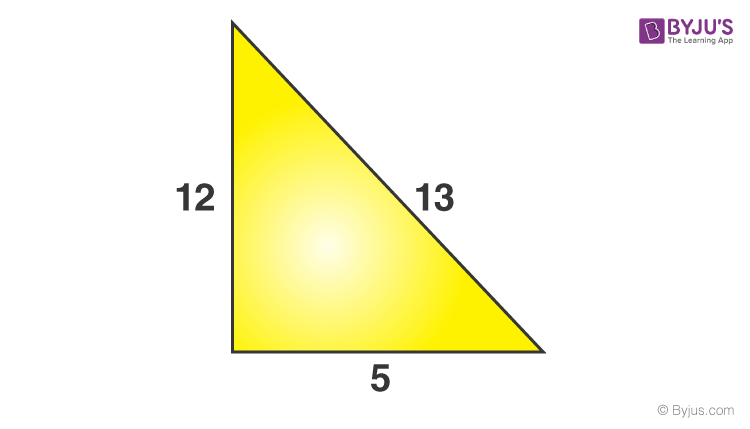
Problem 1: The sides of a triangle are 5, 12 & 13 units. Check if it has a right angle or not.
Solution: From Pythagoras Theorem, we have;
Perpendicular2 + Base2 = Hypotenuse2
P2 + B2 = H2
Let,
Perpendicular (P) = 12 units
Base (B)= 5 units
Hypotenuse (H) = 13 units {since it is the longest side measure}
LHS = P2 + B2
⇒ 122 + 52
⇒ 144 + 25
⇒ 169
RHS = H2
⇒ 132
⇒ 169
⇒ 169 = 169
L.H.S. = R.H.S.
Therefore, the angle opposite to the 13 units side will be a right angle.
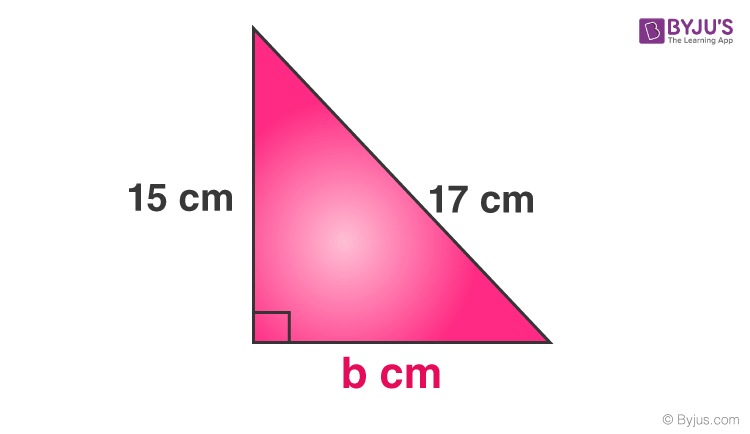
Problem 2: The two sides of a right-angled triangle are given as shown in the figure. Find the third side.
Solution: Given;
Perpendicular = 15 cm
Base = b cm
Hypotenuse = 17 cm
As per the Pythagorean Theorem, we have;
Perpendicular2 + Base2 = Hypotenuse2
⇒152 + b2 = 172
⇒225 + b2 = 289
⇒b2 = 289 – 225
⇒b2 = 64
⇒b = √64
Therefore, b = 8 cm
Problem 3: Given the side of a square to be 4 cm. Find the length of the diagonal.
Solution- Given;
Sides of a square = 4 cm
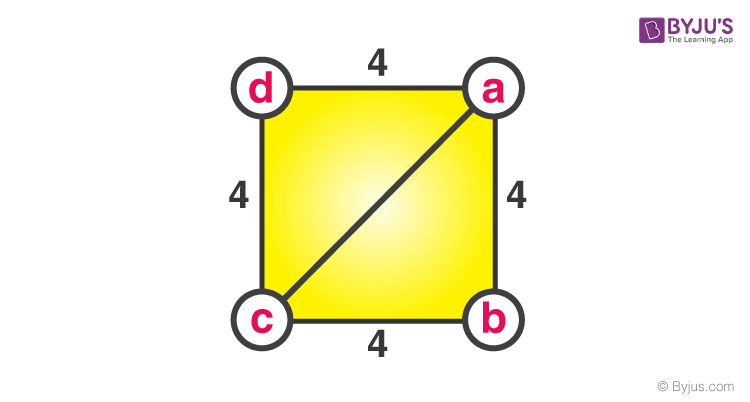
To Find- The length of diagonal ac.
Consider triangle abc (or can also be acd)
(ab)2 +(bc)2 = (ac)2
(4)2 +(4)2= (ac)2
16 + 16 = (ac)2
32 = (ac)2
(ac)2 = 32
ac = 4√2.
Thus, the length of the diagonal is 4√2 cm.
References
- ^ a b Judith D. Sally; Paul Sally (2007). "Chapter 3: Pythagorean triples". Roots to research: a vertical development of mathematical problems. American Mathematical Society Bookstore. p. 63. ISBN 978-0-8218-4403-8.
- ^ Benson, Donald. The Moment of Proof : Mathematical Epiphanies, pp. 172–173 (Oxford University Press, 1999).
- ^ Euclid (1956), pp. 351–352
- ^ Huffman, Carl (23 February 2005). "Pythagoras". In Zalta, Edward N. (ed.). The Stanford Encyclopedia of Philosophy (Winter 2018 Edition)., "It should now be clear that decisions about sources are crucial in addressing the question of whether Pythagoras was a mathematician and scientist. The view of Pythagoras's cosmos sketched in the first five paragraphs of this section, according to which he was neither a mathematician nor a scientist, remains the consensus."
- ^ Alexander Bogomolny. "Cut-the-knot.org: Pythagorean theorem and its many proofs, Proof #4". Cut the Knot. Retrieved 4 November 2010.
- ^ Alexander Bogomolny. "Cut-the-knot.org: Pythagorean theorem and its many proofs, Proof #3". Cut the Knot. Retrieved 4 November 2010.
Comments
Post a Comment